
Today’s Gold Rate in Jaipur
Current source-reported reference
Source: Groww · Quote date: · Retrieved: UTC. Retrieval time is not quote time.
| Purity | INR / gram | INR / 10g |
|---|---|---|
| 24K | ₹14,841 | ₹1,48,410 |
| 22K | ₹13,604 | ₹1,36,040 |
| 18K | ₹11,131 | ₹1,11,310 |
24K · change / 10g−₹1,030 (−0.69%)
22K · change / 10g−₹950 (−0.69%)
18K · change / 10g−₹770 (−0.69%)
Dashes mean no accepted city value is available; they are not zero and no nearby, national or older rate is substituted. These are indicative metal references, not a live or binding dealer quote. Making charges, tax and other fees must be confirmed on an itemised quotation.
Compare with 13 October 2026: previous reference
| Purity | INR / gram | INR / 10g |
|---|---|---|
| 24K | ₹14,944 | ₹1,49,440 |
| 22K | ₹13,699 | ₹1,36,990 |
| 18K | ₹11,208 | ₹1,12,080 |
On this page · 13 sections
Gold Price History in Jaipur
Source: Groww · Quote date: · Retrieved: UTC. Retrieval time is not quote time.
Source: Groww · Quote date: · Retrieved: UTC. Retrieval time is not quote time.
Groww · Jaipur · dated history · INR per 10 grams. Only rows fetched from the selected source series are used. Missing days are not filled, and different providers are not spliced together.
Swipe or scroll horizontally to see every column on smaller screens.
| Date | 24K / 10g (₹) | 24K daily change | 22K / 10g (₹) | 22K daily change | 18K / 10g (₹) |
|---|---|---|---|---|---|
| 14 October 2026 | ₹1,48,410 | −₹1,030 (−0.69%) | ₹1,36,040 | −₹950 (−0.69%) | ₹1,11,310 |
| 13 October 2026 | ₹1,49,440 | −₹1,690 (−1.12%) | ₹1,36,990 | −₹1,550 (−1.12%) | ₹1,12,080 |
| 12 October 2026 | ₹1,51,130 | −₹440 (−0.29%) | ₹1,38,540 | −₹400 (−0.29%) | ₹1,13,350 |
| 11 October 2026 | ₹1,51,570 | ₹0 (0.00%) | ₹1,38,940 | ₹0 (0.00%) | ₹1,13,680 |
| 10 October 2026 | ₹1,51,570 | +₹710 (+0.47%) | ₹1,38,940 | +₹650 (+0.47%) | ₹1,13,680 |
| 9 October 2026 | ₹1,50,860 | +₹1,160 (+0.77%) | ₹1,38,290 | +₹1,060 (+0.77%) | ₹1,13,150 |
| 8 October 2026 | ₹1,49,700 | ₹0 (0.00%) | ₹1,37,230 | ₹0 (0.00%) | ₹1,12,280 |
| 7 October 2026 | ₹1,49,700 | +₹530 (+0.36%) | ₹1,37,230 | +₹490 (+0.36%) | ₹1,12,280 |
| 6 October 2026 | ₹1,49,170 | −₹160 (−0.11%) | ₹1,36,740 | −₹150 (−0.11%) | ₹1,11,880 |
| 5 October 2026 | ₹1,49,330 | No verified baseline | ₹1,36,890 | No verified baseline | ₹1,12,000 |
10 verified rows shown; no invented ten-day series. Daily changes require a consecutive preceding-date row from the same source. The oldest available row has no verified baseline. History does not predict returns.
Gold Price Calculator
Illustrative jewellery-cost calculator
Enter net gold weight, not stone-inclusive gross weight. Fees and tax are not prefilled. The rate starts with the dated, purity-matched reference where available; confirm its basis before use. Values remain in this browser and are not transmitted.
This is illustrative arithmetic, not a dealer quote, invoice, tax determination, appraisal or recommendation. Tax treatment and charges depend on the actual item and invoice.
Compare Jaipur with Other Cities
Matched-date city references
All entries below carry the same displayed quote date: 14 October 2026. Values are per 10 grams and source-labelled; provider differences are shown and do not establish a dealer spread, cheapest city or arbitrage.
| City | 24K / 10g | 22K / 10g | 18K / 10g | Provider |
|---|---|---|---|---|
| Jaipur | ₹1,48,410 | ₹1,36,040 | ₹1,11,310 | Groww |
| Sikar | ₹1,48,410 | ₹1,36,040 | ₹1,11,310 | Groww |
| Sri Ganganagar | ₹1,48,410 | ₹1,36,040 | ₹1,11,310 | Groww |
| Ajmer | ₹1,48,410 | ₹1,36,040 | ₹1,11,310 | Groww |
Each local city link opens its own dated reference page. Missing values remain dashes; they are not zero or an implied price difference.
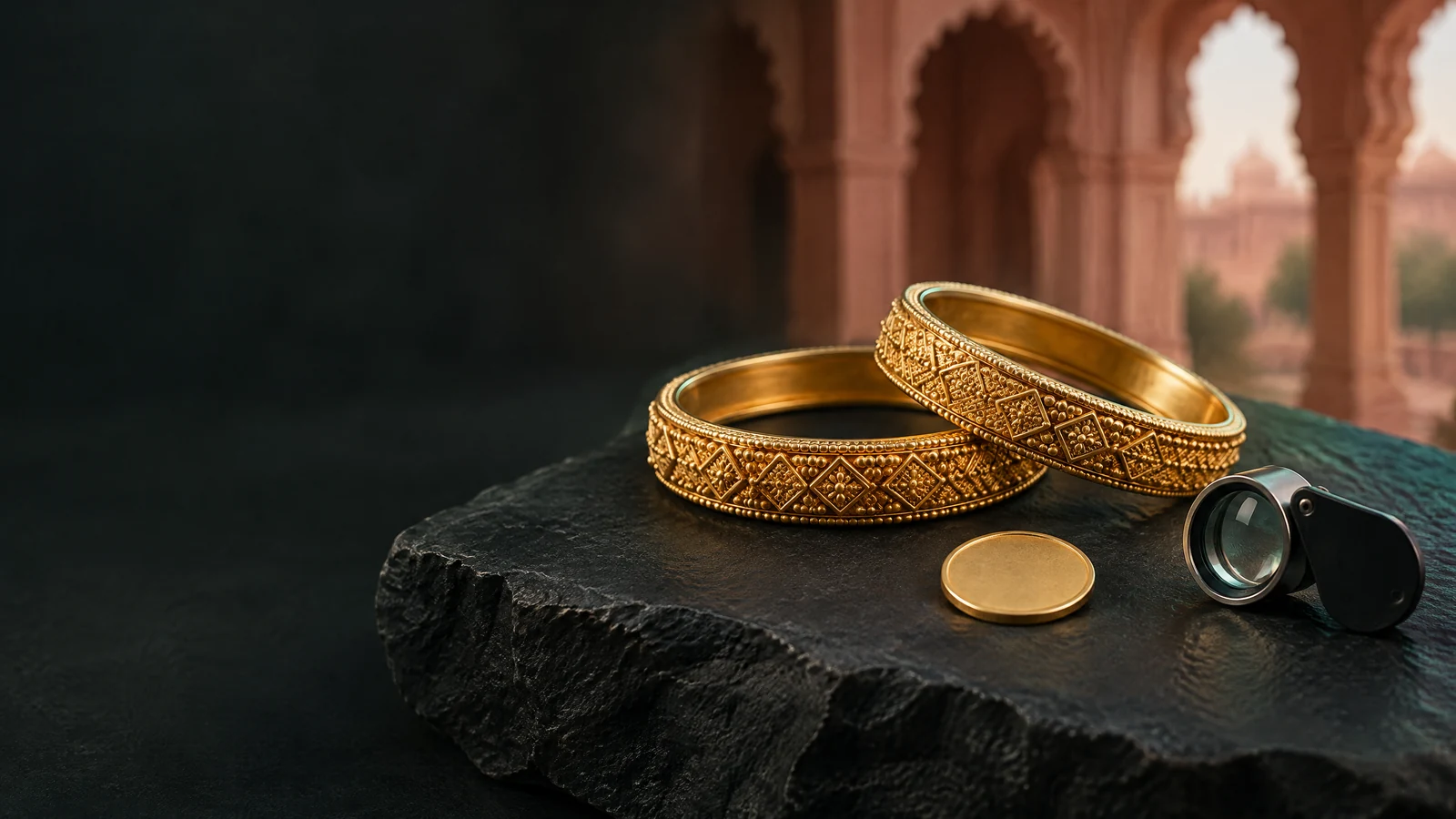
Read a Jaipur jewellery invoice before comparing a rate
A city rate table is a useful reference for metal value, not a finished-jewellery quotation. The practical question for a Jaipur buyer is not simply whether one displayed rate is lower than another. It is whether two quotations describe the same purity, the same amount of gold and the same additions. A rate board cannot answer that by itself.
Begin with the purity written for the article and the rate the seller says will be applied. Then ask for the net gold weight. Gross weight can include stones, beads, enamel or other non-gold parts, depending on the design. If a component is not gold, it should not silently become part of a per-gram gold calculation. Ask the seller to identify the weight and value basis used for each material.
A workable comparison sheet has seven lines:
- Purity and fineness stated for the item.
- Applied gold rate per gram and the time or date on which it applies.
- Net gold weight used for the gold-value calculation.
- Gold value: applied rate multiplied by net gold weight.
- Making or workmanship charge, with the method clearly stated.
- Value of stones or other non-gold components, if any, plus any separately disclosed charge.
- Tax line and the final payable total.
Making charges deserve their own line, not an assumption. Ask whether a quote is a flat amount, a per-gram amount, a percentage, or a design-specific total. Ask the same question about any wastage line. Those labels alone do not make two charges comparable; the written calculation does. A plain design and a detailed piece may have different work, but that is a reason to inspect the invoice, not a reason to accept an unexplained total.
For national market context, use the dated India gold-rate overview alongside broader commodity-trading coverage. Neither replaces the seller’s written Jaipur quotation or the final invoice.
Purity: compare the marked article, not just the heading
24K, 22K and 18K are different quotation bases. The city widgets keep these references separate, so the first comparison rule is to match a rate to the purity on the item. A high-purity reference should not be substituted for the rate of a lower-purity ornament merely because the figures appear on the same board.
In everyday jewellery language, 22K is commonly associated with 916 fineness and 18K with 750 fineness. The exact article mark and seller documentation matter more than a verbal shorthand. Alloy content is part of what distinguishes the purities; design, construction and non-gold components can still make two pieces with the same fineness very different products.
A useful invoice comparison therefore starts with a narrow question: does the quoted rate match the stated purity and net gold weight of this specific item? Only after that should making work, stones and tax be added. Comparing visual size, gross weight, or a headline discount without those fields can produce a misleading result.
For coins or bars, ask for the product’s stated fineness, weight, total price and any written purchase or resale terms. For ornaments, add the item’s workmanship and component breakdown. In both cases, a dated city reference is not a guarantee of stock, a retailer’s final selling price, or a later resale value.
Turn two quotations into a like-for-like comparison
Put each seller’s written quote in adjacent columns. Leave a field blank rather than guessing. If one seller cannot identify the net gold weight, applied purity or method for calculating making charges, that offer is not yet comparable with an itemised quotation.
| Invoice field | Quote A | Quote B | What to check |
|---|---|---|---|
| Purity/fineness | Seller-stated | Seller-stated | Same article basis, not just a similar design |
| Net gold weight | Seller-stated | Seller-stated | Exclude non-gold component weight from gold value |
| Applied rate | Seller-stated | Seller-stated | Same date/time and purity basis |
| Making charge | Seller-stated | Seller-stated | Amount and calculation method |
| Stones/other components | Seller-stated | Seller-stated | Weight and value explained separately where applicable |
| Tax and other disclosed charges | Seller-stated | Seller-stated | Invoice line and calculation basis |
| Final total | Seller-stated | Seller-stated | Reconcile it to every preceding line |
The GST Council’s Gems & Jewellery FAQ says, in its customer-jewellery example, that GST is payable at 3% of the total transaction value whether making charges are shown separately or not. Its next answer addresses a job-work situation, which is a different transaction. This is explanatory source material, not a determination of the treatment of a particular sale. Confirm the tax line, the amount it is applied to and the invoice total at purchase. The accepted Jaipur rate board does not confirm whether its displayed reference is tax-inclusive.
A discount is only meaningful after the base is known. For example, a reduction in a making-charge line cannot be evaluated if the quote silently uses a different purity, net weight or rate. Retain screenshots or written quotations with their date, and request an itemised invoice before payment.
Why a Jaipur board and an invoice can move differently
A displayed city reference can change when its publisher updates the underlying inputs or its own city series. Gold’s broader market price and the rupee value used by a provider can also change. Those mechanisms help explain why a reference may vary over time, but they do not establish the cause of any one daily move and do not forecast the next one.
A retailer’s invoice adds a separate commercial layer: the item, its net gold content, workmanship, stones or other components, and tax calculation. That is why a small movement on a rate table may be less important to a finished-jewellery total than one unexplained invoice line. Do not use historical movement as a prediction or as evidence that a particular shop will revise its rate by the same amount.
The history widget is deliberately source-specific. It uses the accepted provider’s dated Jaipur rows rather than blending other publishers’ series. Repeated values are preserved as reported; they are not assumed to mean a market was closed, that every retailer held the same rate, or that a specific event caused no movement.
Nearby-city reading: dates and units first
A city-to-city table is most useful as a consistency check, not a travel or arbitrage signal. Before drawing a conclusion, match the date, purity, unit, source definition and charge treatment. A city reference does not establish that two jewellers offer identical products, invoice methods, stock or exchange terms.
For Rajasthan context, compare the separate dated pages for Sikar, Ajmer and Sri Ganganagar. For wider state comparisons, the independently maintained pages for Kota, Jodhpur and Jaisalmer should be read on their own stated source and date. These links are comparison references, not evidence that a seller must match another city’s board.
For a Jaipur purchase, the strongest comparison remains two complete written invoices for the same or genuinely comparable items. The city label is one data point; purity, net weight and charges determine whether the totals can be evaluated fairly.
BIS hallmarking and paperwork checks
The Bureau of Indian Standards hallmarking overview describes hallmarking as the accurate determination and official recording of the proportionate precious-metal content in an article. That makes a hallmark check a purity-documentation step, not a substitute for reviewing the bill.
Before paying, inspect the article’s applicable marking and compare the stated fineness with the invoice description. Keep the invoice, product documentation and any written exchange or return terms. If an item contains stones or detachable/non-gold parts, ask how the seller has recorded their weight and value. If the tag, article mark and invoice do not agree, pause and ask for a written explanation before completing the purchase.
BIS resources also list consumer-protection and hallmarking information. Their availability does not guarantee a particular item, seller, price or outcome. A buyer should use the official information relevant to the article in hand and retain documentation if a later question arises.
A short buyer checklist
- Match the displayed reference and the seller’s applied rate to the item’s stated purity.
- Ask for net gold weight, not only gross weight.
- Request the making-charge method in writing.
- Separate stone or other non-gold value from gold value where relevant.
- Reconcile the tax line and final total to the itemised quotation.
- Inspect the applicable hallmark/fineness information and retain the invoice.
- Read written exchange, buyback and return terms before treating them as part of the comparison.
Frequently Asked Questions
Does a Jaipur gold-rate board include making charges?
A rate board is a metal reference unless the source or seller expressly states otherwise. Treat making charges as a separate invoice line and ask how they have been calculated for the specific item.
How should I compare two jewellery quotes?
Match purity, applied rate, net gold weight, making-charge method, non-gold components, tax line and final total. If a field is absent, seek clarification rather than filling it in from another quote.
Why is net gold weight more useful than gross weight?
Gold value should relate to the gold content used in the seller’s calculation. Gross weight may include non-gold material depending on the design, so it is not automatically the right quantity for a per-gram gold comparison.
Can I use a 24K reference to price a 22K or 18K ornament?
No. Compare each item with the rate basis that matches its stated purity. The marked fineness and written invoice should guide the calculation for that article.
Are tax and invoice charges already included in the displayed rate?
Do not assume so. The accepted city reference does not verify tax inclusion. Check the invoice’s tax line, its calculation base and every separately disclosed charge before relying on a final total.
What does a BIS hallmark check help me verify?
It helps with the stated purity or fineness documentation of an article. It does not establish the making charge, stone value, seller’s rate, return terms or whether an invoice total is correct.
Can the history chart tell me what gold will do next?
No. It records selected dated source rows. A historical series is useful for reviewing reported changes, not for predicting price direction, a jeweller’s next quote or an investment outcome.
Sources and Methodology
Selected pricing source: Groww, explicitly dated 14 October 2026. Checked 2026-10-14T05:38:43Z UTC; retrieval time is not quote time. Exact intraday quote time is unavailable. The selected rate board does not certify GST or charge inclusion. Confirm tax, making charges, wastage, stones and premiums on the seller’s itemised quotation. Other publisher references can differ. This is the selected named-source snapshot, not a universal city price.
Invoice and purity guidance. The invoice discussion cites the GST Council Gems & Jewellery FAQ for its stated customer-jewellery example and the BIS Hallmarking Overview for general hallmarking context. These sources do not make this page a retailer quotation, tax ruling or product certification.
Financial information disclaimer
This page is general educational information, not investment, tax, legal or purchase advice. Gold prices and retailer terms can change. Verify the actual item, applicable tax treatment, invoice calculations, hallmark information and written seller terms before buying or selling.