
Gold education · India
22K vs 24K Gold: Purity, Hallmarks and Buying Basics
Learn what 916, 995 and 999 mean, compare jewellery and bullion, and check purity, net weight and costs without confusing them with investment returns.
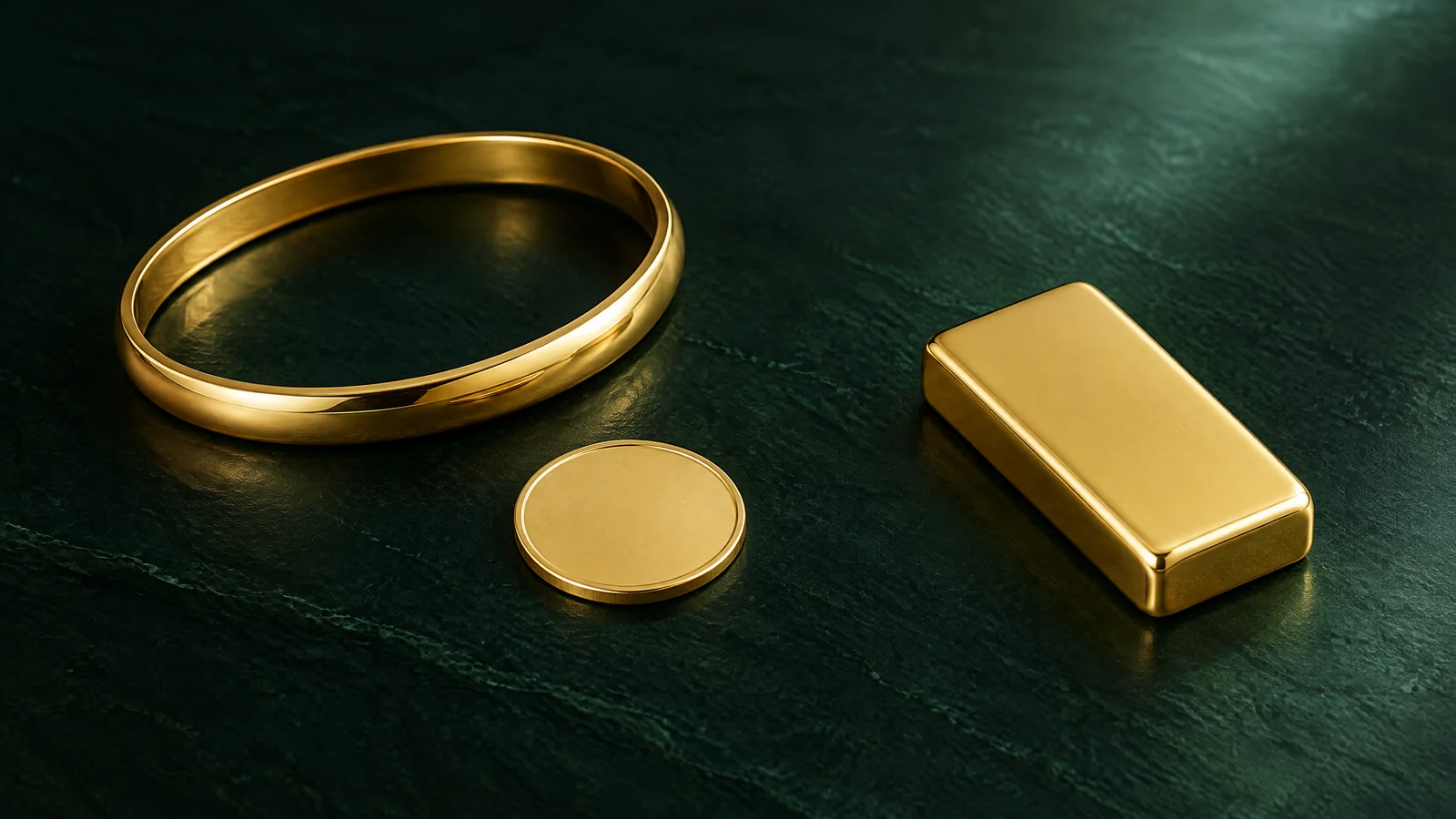
Declared jewellery grade. Alloyed for practical properties; design still matters.
99.5% versus 99.9%. Check the exact product, mark and invoice.
22K gold is a high-gold-content alloy; 24K describes the highest carat category. In India, the familiar 22K916 hallmark identifies 916 parts gold per thousand, or 91.6%. A 24K product still needs a precise fineness: 995 means 99.5%, 999 means 99.9%, and 999.9 means 99.99%. They are not interchangeable specifications. [1] [2] [3]
For a jewellery buyer, purity is only one part of the decision. Construction, net metal weight, making charges, stone costs and the seller’s written exchange terms also matter. For someone comparing bars or coins, the questions shift towards authenticity, exact fineness, premium, storage and the difference between the purchase and resale price.
This guide explains the differences without treating either category as universally better. It is an educational companion to TradeGrows’ commodity market overview, not a dealer quotation, an assay report or a recommendation to buy gold.
Key takeaways
- Read the numerical fineness, not only “22K” or “24K”. A 916 and a 999 item contain different amounts of gold at the same net metal weight.
- Alloying can improve practical durability, but design and manufacturing still affect how jewellery wears.
- HUID verification, the actual article and the invoice should agree. A hallmark concerns purity, not future returns or a guaranteed buyback price.
- Separate fine-gold arithmetic from a purity-specific retail rate. Applying a purity factor twice understates the calculation.
22K vs 24K: side-by-side comparison
| What to compare | 22K916 jewellery grade | 24K / high-purity product |
|---|---|---|
| Numerical purity | 916 parts per thousand = 91.6% gold | Read the specific 995, 999 or 999.9 fineness; do not assume they are identical |
| Gold content in 10 g of net alloy | 9.160 g, assuming 916 conformity | 9.950 g at 995; 9.990 g at 999; 9.999 g at 999.9 |
| Material characteristics | Alloying can improve practical durability | Relatively soft at high purity; construction and intended use matter |
| Product comparison | Evaluate the particular ornament, fastening and net metal weight | Establish whether the product is jewellery, a bar or a coin |
| Verification | Match article, hallmark, HUID record and invoice | Check the relevant jewellery or refinery/mint scheme; a fineness stamp alone is not proof |
| Purchase cost | Metal component plus the actual design, stones, charges and taxes | Metal component plus any fabrication, premium, packaging and applicable costs |
| Resale or exchange | Written terms, verified content and deductions matter | Higher purity does not guarantee a return or a fixed buyback price |
The purity and material statements are grounded in BIS, World Gold Council and GIA guidance. Product-cost and resale rows are comparison questions, not claims about a particular seller’s policy. [1] [2] [3] [4]
What 22K and 24K actually mean
Caratage, also written as karatage, expresses gold purity on a 24-part scale. The World Gold Council describes 24 carat as pure gold in the conceptual scale and lower caratages as gold mixed with other metals. The same source explains that commercial purity is stated more precisely as fineness in parts per thousand. [2]
22K: a gold alloy, not automatically an inferior product
On the theoretical carat scale, 22 out of 24 parts are gold. The exact fraction is 22 ÷ 24, which gives a repeating percentage of 91.666…%. Indian hallmarking identifies the recognised 22K jewellery grade as 22K916. That numerical fineness means 91.6%, not exactly 91.666…%. Use the stated 916 specification in an educational calculation about a 916 item. Do not replace it with an unlabelled rounding rule. [1] [2]
The remaining portion consists of other metals. Copper and silver are common examples, but a karat label does not reveal the manufacturer’s full alloy recipe. Different blends can change colour, hardness and working characteristics. Alloying itself is not a sign of fraud when the item is honestly described and meets its declared fineness. [2] [4]
24K: check the exact product specification
The expression “24K” alone does not tell you whether a particular product is described as 995, 999 or 999.9 fine. BIS’s general jewellery FAQ identifies 24KS(995), while its refinery FAQ lists 999 or 995 in the scope of gold bullion and gold-coin licences. The product category and numerical specification therefore matter. [1] [3]
This does not mean every bar is BIS-certified, or that every product advertised as 24K has the same specification. Read the mark, invoice and issuer information together. A stamp claiming “999” is a claim about content; it is not, by itself, proof that a recognised authority has tested that particular item.
How to read 916, 995, 999 and 999.9
Fineness is a proportion, not a weight. Divide the fineness number by 1,000 to convert it into a fraction of the metal mass. Thus 916 becomes 0.916 and 999 becomes 0.999. The percentage is that fraction multiplied by 100. [2]
For 10 grams of net gold-alloy mass, the declared fine-gold content works out as follows:
- 916 fineness:
10 × 916 ÷ 1,000 = 9.160 gof fine gold. - 995 fineness:
10 × 995 ÷ 1,000 = 9.950 gof fine gold. - 999 fineness:
10 × 999 ÷ 1,000 = 9.990 gof fine gold. - 999.9 fineness:
10 × 999.9 ÷ 1,000 = 9.999 gof fine gold.
These calculations assume that the article conforms to its declared fineness and that the input is net metal mass. They are not purity tests. The difference between 995 and 999 in this example is 0.040 g of fine gold, calculated as 10 × (999 − 995) ÷ 1,000. That difference is small in weight, but it is still a real specification difference.
An advertised “10 g product” needs context. If that is the weight of an ornament including stones or non-metal components, it cannot automatically be used as 10 g of gold alloy. Net precious-metal weight should be separately identified.
Jewellery, bars and coins serve different purposes
A 22K bangle and a 24K bar are not simply two versions of the same purchase. One includes design and wearability; the other may put more emphasis on a clearly specified metal product. The comparison should reflect what the object will actually be used for.
Jewellery and everyday wear
Pure gold is relatively soft. GIA explains that jewellery makers alloy gold with metals such as copper and silver to improve strength and durability. The World Gold Council similarly describes alloying as a way to improve the durability of malleable gold. [2] [4]
That helps explain the practical use of 22K jewellery, but it does not make every 22K design suitable for every activity. A thin chain, hollow bangle or delicate fastening may be vulnerable regardless of its purity label. The relevant questions are how the article is constructed, how it will be worn and what repair or care the manufacturer recommends.
Bars, coins and handling
Higher-purity bars and coins provide a way to hold a defined metal product. Their purchase price can nevertheless include fabrication, packaging, distribution or brand premiums. Ask which fineness, weight and issuer are being supplied, and what the seller would pay to buy that product back.
Do not assume a high-purity coin has to use the same marking arrangement as jewellery. BIS treats refinery/mint bullion and coin licensing as a distinct scheme. Jewellery HUID guidance should not be applied mechanically to every bullion product without checking the relevant scheme. [3]
24K jewellery is not impossible
“24K cannot be made into jewellery” is too broad. BIS’s FAQ includes a high-purity jewellery/artefact grade, and manufacturers can design high-purity pieces for particular uses. The more useful point is that high purity changes the material’s working and wear characteristics. It does not make every design practical for heavy daily use. [1] [2] [4]
Strength, colour and skin sensitivity
A purity label is not a complete performance specification. Alloy mix, thickness, workmanship and the shape of the article influence wear. A comparison should not promise that a 22K item will never bend or that a 24K item will immediately fail. The relative softness of pure gold is a material property, not a prediction about every finished product. [4]
Gold colour can also be influenced by alloy metals and surface treatment. Copper can produce a pinker tone, while other metals can produce white-gold alloys. Lighting and surface finish further affect how the object appears. Colour alone cannot establish whether an item is 916, 995 or 999 fine. [2] [4]
Nor does a higher karat label guarantee that jewellery is suitable for every person’s skin. GIA discusses sensitivity to alloy metals. Ask about the actual composition if you have a known sensitivity, and seek appropriate medical advice for a reaction rather than relying on a purity slogan. [4]
Why 24K prices cannot simply become 22K retail prices
More fine gold per gram generally increases the gold-content component when the pricing benchmark and other conditions are the same. But a jewellery quotation is not only a calculation of fine-gold content. It can include workmanship, stones, premiums, charges and taxes.
There are two different calculation bases to keep separate.
Fine-gold benchmark basis: If the input rate is explicitly per gram of fine gold, multiply net alloy weight by its fineness fraction and then by that rate. This estimates only the assumed gold-content component.
Purity-specific product-rate basis: If the seller has already quoted a rate per gram for 22K jewellery, multiply that 22K rate by the relevant net 22K metal weight. Do not multiply by 0.916 again unless the seller explicitly says the rate has a different basis.
For example, a hypothetical 22K product rate of ₹10,000 per gram of 22K metal and 10 g of net 22K metal gives 10 × ₹10,000 = ₹1,00,000 before other charges. Multiplying that result by 0.916 would incorrectly apply the purity adjustment twice for this stated basis. ₹10,000 is invented solely for this teaching example; it is not today’s gold rate.
For dated reference boards rather than hypothetical arithmetic, use the India gold-rate page. Check its source, unit, purity, date and tax-status note. A national reference is not a substitute for an executable local quotation. TradeGrows’ market-data method explains why the status of a number matters.
A worked example: net weight and fine-gold value
Suppose an ornament has a gross weight of 12 g, including 2 g of stones and other non-metal components. For this simplified example, the remaining 10 g is all 916 gold alloy. Its fine-gold content is:
(12 − 2) × 916 ÷ 1,000 = 9.160 g
Now assume a hypothetical fine-gold benchmark of ₹10,000 per gram of fine gold. The gold-content component would be 9.160 × ₹10,000 = ₹91,600. If a hypothetical making charge of ₹4,000 is added, that creates a subtotal of ₹95,600 before stones, other charges and applicable taxes.
This is deliberately not a final invoice. It assumes verified weights, the declared fineness, a separately defined fine-gold benchmark and no additional metal components. Actual sellers may quote on a purity-specific product basis instead. The correct starting point is the seller’s written calculation, not an assumption that every jeweller uses this method.
The fine-gold-content tool on this page reproduces only net alloy weight × fineness ÷ 1,000. It does not assess authenticity, retrieve prices, estimate tax or calculate a resale offer.
What to check on a BIS-hallmarked article
BIS describes hallmarking as the determination and official recording of precious-metal content. Its general FAQ says the HUID-era gold-jewellery hallmark consists of the BIS logo, purity in caratage and fineness, and a six-character alphanumeric HUID. This is more information than a standalone “22K” stamp. [1]
A practical check is to inspect the marks on the actual article, use the Verify HUID feature in the official BIS Care app, and compare the returned record with what you are being sold. PIB explains that the record can identify the jeweller’s registration, purity, article type and hallmarking centre. [8]
The code and article need to match. A screenshot supplied by a seller is not a substitute for inspecting the item and checking its record yourself. A successfully retrieved HUID record is also not an independent laboratory test of an arbitrary object: verification needs to be connected to the actual marked article.
BIS’s general FAQ advises checking each article in a pair and detachable parts for their own hallmark details and different HUIDs. This is particularly relevant when jewellery is sold as a matching pair or includes removable components. [1]
This guide explains consumer verification; it does not claim that all products, sellers or locations have identical legal obligations. Check current BIS guidance for the applicable category and transaction rather than relying on a blanket statement about every gold item.
What the invoice should separate
An authentic invoice is useful even when the article is hallmarked. BIS’s jeweller guidelines specify separate article descriptions, net precious-metal weight, purity in carat and fineness, and hallmarking charges. The guidelines also require the bill or invoice to state that consumers can get the purity verified at a BIS-recognised assaying and hallmarking centre. [7]
For your own comparison, also ask the seller to show the rate basis, stone or other component costs, making charges, any stated wastage charge, other fees and applicable taxes. A percentage making charge needs a clear denominator: percentage of which amount? A per-gram charge needs a clear weight basis.
Hallmarking charges are not the same as making or wastage charges. BIS explicitly distinguishes them in its FAQ. A purity assurance should not be presented as proof that workmanship charges or the final invoice are economically favourable. [1]
Do not assume a displayed gold rate includes tax. This page deliberately gives no universal tax-inclusive invoice formula or personal tax advice. Obtain an itemised tax invoice and clarify the treatment of the actual transaction.
Resale, exchange and the limits of “investment value”
Higher purity does not guarantee a higher percentage return. A resale offer depends on verified metal weight and purity, the buyer’s applicable rate, deductions and the product’s condition or documentation. The amount paid originally for workmanship, stones, packaging or a premium is not automatically the amount recovered later.
Ask for the seller’s written buyback and exchange terms before treating the word “investment” as meaningful. Is there a difference between cash buyback and exchange credit? Does a policy apply only to the seller’s own products? What testing, melting or handling deductions could apply? Will stones be valued separately?
These questions prevent unlike offers from being compared as if they were the same. They do not predict a market price or endorse a product. Gold prices can fall, and holding physical gold can involve storage, security and transaction costs. A hallmark does not guarantee returns, liquidity or a fixed resale price.
For the same net metal weight, 999 contains more fine gold than 916. For the same amount of fine gold, however, a 916 article needs more alloy mass. Those are arithmetic relationships—not a conclusion that one purchase is right for a particular person.
If the marks or purity do not match
Pause if the physical marks, HUID record, product description and invoice disagree. Keep the invoice and a clear record of the discrepancy. Avoid resolving a disputed purity claim with colour, a magnet or a home acid test: such observations are not a replacement for the relevant assay and can damage an article.
BIS’s consumer-protection guidance says consumers can have jewellery or samples tested at a BIS-recognised assaying and hallmarking centre, with an assay report identifying the article. Ask about the method, fee and whether the procedure changes or damages the item before authorising a test. [6]
BIS also provides a complaints process through BIS Care and its official channels. TradeGrows’ guide to verifying market claims explains the broader habit of checking the original authority rather than trusting forwarded screenshots. This article is not a substitute for a formal consumer complaint or an expert test. [5]
Common misunderstandings about 22K and 24K
“916 means 91.67%.” The theoretical fraction 22 ÷ 24 and the marked fineness 916 are different ways of expressing a grade. For an item specified as 916, the numerical fineness is 91.6%.
“24K always means exactly 100%.” The ideal carat scale is not a complete commercial product specification. Read the actual 995, 999 or 999.9 fineness and supporting documentation.
“22K is fake because it contains other metals.” Declared alloying is normal. The issue is whether the product meets its stated grade, not whether it is an alloy.
“A rich yellow colour proves purity.” Colour is affected by composition and appearance. It is not an assay.
“A hallmark guarantees full-value buyback.” Hallmarking concerns purity. The seller’s commercial terms, deductions and prevailing rate determine an offer.
“Gold purity and diamond carat weight are the same.” In this guide, K refers to gold purity. A gemstone’s carat weight is a measure of mass; it is not a gold fineness grade.
Frequently asked questions
Is 22K the same as 916 gold?
In Indian hallmarking, the recognised 22K jewellery grade is identified as 22K916. The number 916 means 916 parts gold per thousand, or 91.6%. The hallmark and invoice should state the grade rather than relying only on a verbal claim. [1]
Is 24K gold 995 or 999?
Read the specific product. BIS’s jewellery FAQ identifies 24KS(995), while the refinery/coin scheme lists both 999 and 995. “24K” is not enough information to infer the exact fineness of every commercial item. [1] [3]
Is 24K jewellery unsuitable for everyone?
No. High-purity jewellery can exist, but pure gold’s relative softness affects construction and wear. Evaluate the particular design and intended use instead of treating purity as a universal durability score. [1] [4]
Is 22K or 24K better for saving money?
There is no universal answer or guaranteed return. Compare fine-gold content, all-in purchase costs, authenticity, storage and written resale terms. A jewellery purchase also pays for design and workmanship. This page does not give personalised investment advice.
Can I calculate a 22K rate by multiplying a 24K rate by 22/24?
That can be a simplified purity-content illustration only when both input specifications and the benchmark basis are explicitly defined. It is not a verified retail quote. For 916 content use 0.916; also distinguish whether the so-called 24K benchmark is 995 or 999. Do not adjust an already purity-specific 22K product rate again.
Does gross jewellery weight equal gold weight?
Not necessarily. Stones and non-metal components can be included in gross weight. Use the invoice’s net precious-metal weight for a metal-content calculation, then apply the declared fineness. [7]
Does a valid HUID prove the price is fair?
No. It helps verify hallmarking information when matched to the actual article. It does not validate making charges, a buyback policy, a dealer’s price or an investment outcome. [1] [6]
Can consumers still sell old unhallmarked jewellery?
BIS’s consumer FAQ says consumers can sell old hallmarked or unhallmarked jewellery lying with them to jewellers. The buyer may need to assess it; that does not establish a guaranteed price or eliminate testing and documentation questions. [5]
Where should I look for dated local gold-rate context?
Use a clearly dated reference such as TradeGrows’ Sikar gold page or Jaipur gold page, then obtain a written seller quotation on the same weight, purity and charge basis. A reference board is not a promise that a shop will transact at that price.
Sources and educational scope
Research checked on 14 October 2026. These documents support definitions and consumer checks; they are not live price feeds. TradeGrows did not assay a product or inspect a seller. Source names are provided for independent verification.
- Bureau of Indian Standards — General hallmarking FAQ.
Definitions, 22K916 and 24KS(995), three hallmark components, HUID, invoices and detachable-part checks.
- World Gold Council — Gold jewellery: caratage, fineness and alloys.
Purity scale, parts per thousand, commercial fineness and the role of alloys. Illustrative alloy recipes are not universal product specifications.
- Bureau of Indian Standards — Refineries FAQ.
Separate bullion/coin scheme and licence scope including 999 or 995 fineness. The FAQ’s incomplete mandatory/voluntary sentence is not relied on.
- Gemological Institute of America — Yellow Gold vs. Rose Gold: Discovering the Differences, 1 July 2025.
Qualitative information on softness, alloying, colour and sensitivity. Its rounded composition figures are not used as Indian hallmark specifications.
- Bureau of Indian Standards — Consumers FAQ.
HUID verification, old jewellery and complaint channels.
- Bureau of Indian Standards — Consumer Protection.
Recognised testing centres, assay reports and BIS Care verification.
- Bureau of Indian Standards — Guidelines for Jewellers, July 2026 version, section 7.3.
Invoice particulars and consumer purity-verification information.
- Press Information Bureau — Ministry of Consumer Affairs, 4 March 2023 HUID announcement.
Fields available through Verify HUID. Historical district counts and rollout statistics are not used as current figures.
General education only. This is not an executable quote, proof of a particular product’s purity, a promise of resale value or personalised financial advice. See the TradeGrows editorial policy and financial-information disclaimer.